FlyHouse plans to raise as much as $300 million in a current offering, according to backer Benevolent Capital.
In an email to potential investors, the private capital firm claims, “The $30 billion plus private aviation market is broken.”
In an investor presentation, Benevolent Capital says the 2021 private jet start-up is projecting $420 million in revenue in 2026.
Revenues are expected to more than double to over $900 million in 2027.
FlyHouse expects to grow to $2.64 billion by 2030.
It is also forecasting a net margin of 30%.
The company touts “Q1 2026 path to profitability.”
‘The way to think about FlyHouse is that for the consumer, it is Uber for private jets (download the app and charter a private jet) and for the plane owner, it is aAirBnB for private jets (list your plane on the platform for free and decide what to charge, where it flies, how many passengers, etc. and only pay a percentage of the booking).’
– Benevolent Capital email to potential investors
Benevolent Capital led a previous Series B raise at $100 million pre-money valuation.
The current raise is priced at a $500 million pre-money valuation.
FlyHouse M&A
Funds from this raise will be used to promote its instant booking app, expand its managed fleet to over 100 aircraft, increase operating locations, and develop insurance and credit divisions.
Last year, FlyHouse acquired Sun Air Jets.
The latest FAA data shows Sun Air had 11 aircraft on its Part 135 certificate.
FlyHouse’s certificate shows five aircraft available for charter, per the FAA.
Chairman Sanford L. Michelman tells Private Jet Card Comparisons the company has over 25 aircraft currently on its charter certificate.
The FAA recently disabled its public list due to inaccuracies.
FlyHouse also invested in Patriot National Bank.
SEC filings show affiliates of FlyHouse Management, LLC, co-led a $50 million private placement in March 2025.
The banking relationship will support strategic integration of financial services, an enhanced capital structure, and expanded service offerings for aircraft owners, according to the deck.
What’s next?
One person familiar with FlyHouse’s current financials said that to meet its 2026 revenue targets, it will need to make major acquisitions of brokers, operators, or both.
However, Michelman says the company can achieve those numbers organically based on its current run rate.
He added that FlyHouse is currently profitable on an operating basis.
Michelman says it will be profitable this year, including factoring in capital expenditures.
Private Aviation M&A
FlyHouse’s growth plans come at a crossroads for private aviation.
Start-up fractional Bond, JetExcellence, TLC Jet, Principal Aviation, Leviate Air Group, FlyExclusive, George J. Priester, Monarch Air Group, FlyUSA, and Premier Private Jets have all made acquisitions since the start of 2025.
From late 2024, Flexjet, Vista Global, Wheels Up, Bond, and Surf Air announced over $3 billion in new financing.
Joby acquired Blade’s passenger division.
Kompass Kapital acquired a majority of Airshare in 2024.
At the same time, Wheels Up and Vista Global have been divesting fleets and companies they acquired during acquisition sprees that lasted from 2018 to 2022.
READ: Private Aviation M&A Deal Book
FlyHouse Exit Strategy
Benevolent says the current funding “is anticipated to be the last capital raise before either a potential public offering or a possible strategic exit.”
It expects either the IPO or strategic exit “likely within a two to three year time period.”
FlyHouse App
The lynchpin of the FlyHouse game plan is an instant booking app.
Companies have been trying to digitize the charter market for over two decades.
FlyHouse’s “patent-pending app connects charterers directly to owners in 30-second auctions.”
Benevolent Capital says, “The way to think about FlyHouse is that for the consumer, it is Uber for private jets (download the app and charter a private jet) and for the plane owner, it is aAirBnB for private jets (list your plane on the platform for free and decide what to charge, where it flies, how many passengers, etc. and only pay a percentage of the booking).”
An overview for investors criticizes private jet managment companies, asserting, “Hidden markups on every service. Undisclosed vendor rebates kept by managers. Misaligned incentives favor (the) management company.”
![Issues]()
At the same time, aircraft owners “can’t set charter prices” with “management companies playing favorites.”
‘Bloated Landscape’
A video for investors touts the FlyHouse app, asking, “Ever get the urge to just take off?”
It continues, “Now you can charter a flight in the time it takes to order a coffee.”
The video claims, “Private aviation shouldn’t be as complicated as it is.”
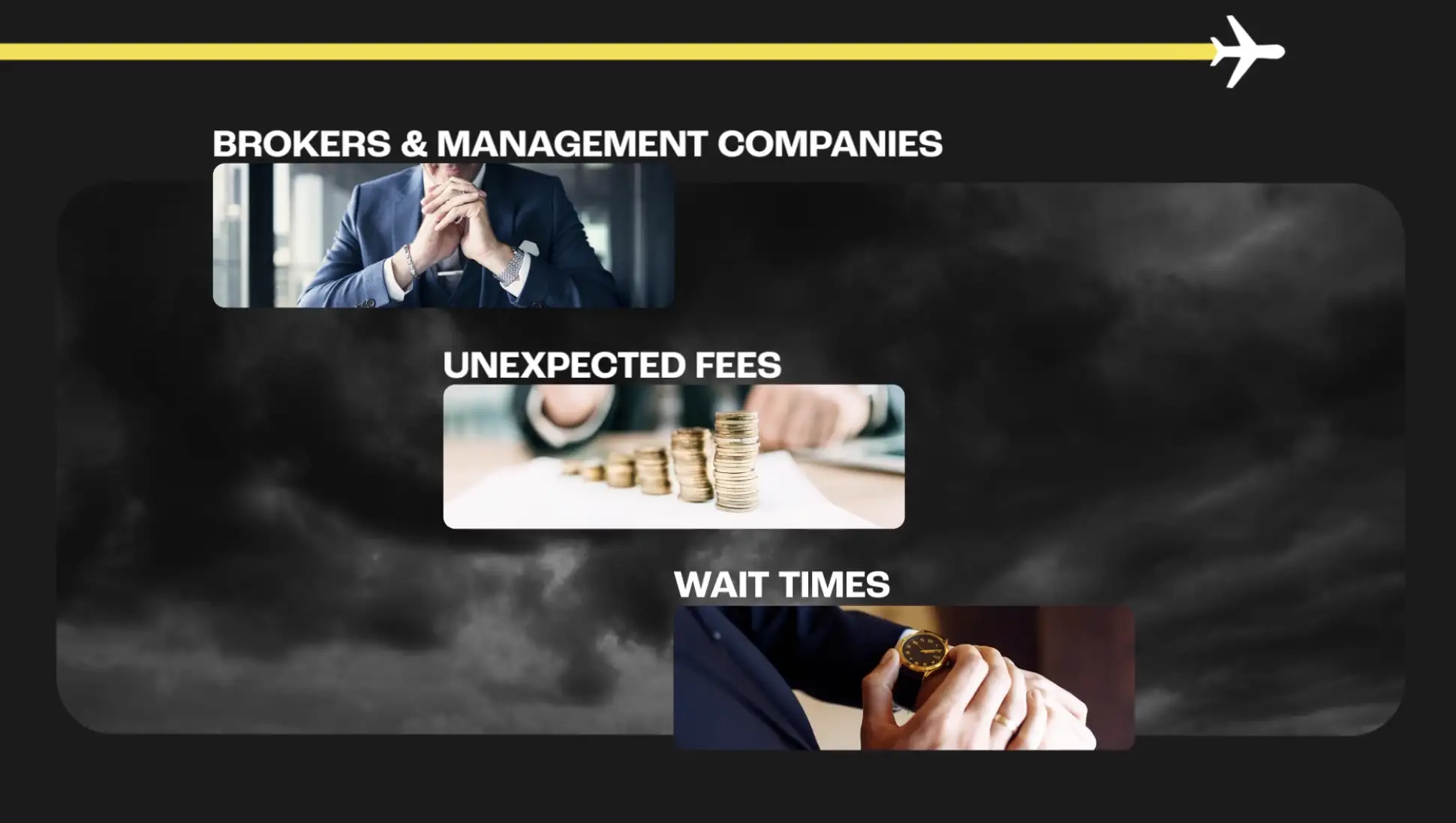
It cites a “bloated landscape of brokers and management companies, unexpected fees, and waiting can make flying private a burden and a time suck.”
The video calls private aviation “an industry stuck in the past while the rest of the world has moved on.”
CEO Jack Lambert, the narrator, says, “If you can book a black car straight from your phone, you should be able to charter a plane just as easily.”
Lambert says of the app, “Simply enter your desired trip plan and watch as hundreds of private plane operators bid to earn your business, driving down the cost of your flight.”
The app includes a feature that lets you invite friends and split the cost.
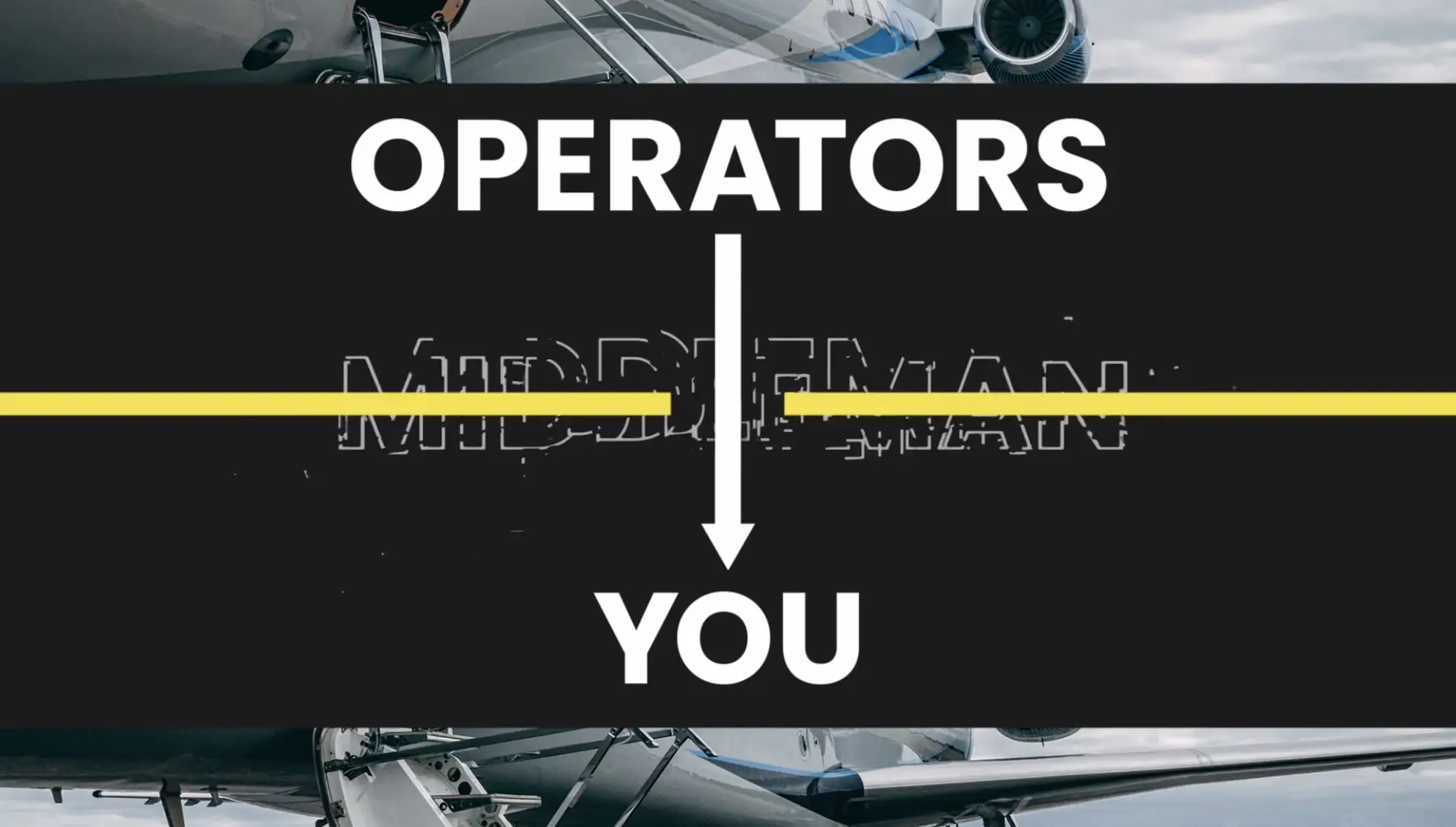
“No more middleman. Deal directly with the operators,” Lambert says in the video.
![FlyHouse app]()
Mixed Messages?
Michelman says the video (screenshot above) has been removed.
He says it was an old video that doesn’t represent the current direction, a two-track approach that includes brokers.
Michelman points to its recent purchase of JetSmith and the appointment of Adam Smith to cultivate the broker community and to use its B2B platform.
A press release last year touted, “No brokers. No waiting. Charterers simply scan, download, and book to begin a group journey that’s about more than the destination.”
However, at the time, Michelman also said cutting out brokers was not the objective.
He said that the initial release was wrong and had been reissued.
Michelman, “In fact, it’s the complete opposite. We welcome and want brokers using FlyHouse.”
He added, “We specifically built a B2B platform, and traditional brokers are a vital part of the flight provider ecosystem.”
FlyHouse Private Jet Network
According to FlyHouse, the app offers 2,300 aircraft for charter.
The company is planning more hooks for users.
House Rewards is planned for 2026.
It will convert credit card interchange fees into flight time credits, “like frequent flyer miles, but for private aviation.”
An enterprise booking system for travel agents, family offices, and business managers will offer direct access to the FlyHouse fleet with “white-label capabilities.”
FlyHouse will also seek ad revenue from luxury brands.
It will offer “premium advertising inventory during 30+ second charter auction periods.”
READ: FlyHouse launches FriendShare jet-sharing app for instant booking
FlyHouse Marketing
FlyHouse touts its sports sponsorships and ambassadors in its pitch.
It points to SponsorUnited Rankings from September 2025, ranking it second on the hottest brands list, ahead of Toyota, Kendra Scott, Progressive Insurance, and 7-Eleven.
It touts “aggressive expansion in positive venues, increase in locker room signage across sports partnerships.”
Partnerships include ESPN for College GameDay and Monday Night Football, the New York Jets, Formula 1, and FlyHouse Polo, among others.
Ambassadors include golfers Justin Rose and Dustin Johnson, Wayne Gretzky, Blake Griffin, and sports commentator Pat McAfee.
Crowded Field
FlyHouse is far from alone.
There are currently around a dozen companies touting digital instant booking for ad hoc charter flights.
Wheels Up and Vista’s XO both allow users to book charter flights in a single session with confirmed pricing.
Last week, Elevate Aviation Group launched its instant booking app.
Broker OneFlight International offers similar instant charter booking via its heavily advertised BAJit app.
Surf Air also lets you book charter flights instantly with confirmed online pricing.
In some cases, the digital booking system serves as a lead-generation tool for the traditional brokerage.
In other cases, they are seeking to take brokering online or, as with FlyHouse, connect consumers and operators directly.
Instant Private Jet Booking Limits
Digital instant-booking brokers and platforms have limitations, according to both traditional brokers and Private Jet Card Comparisons reviews of the interfaces.
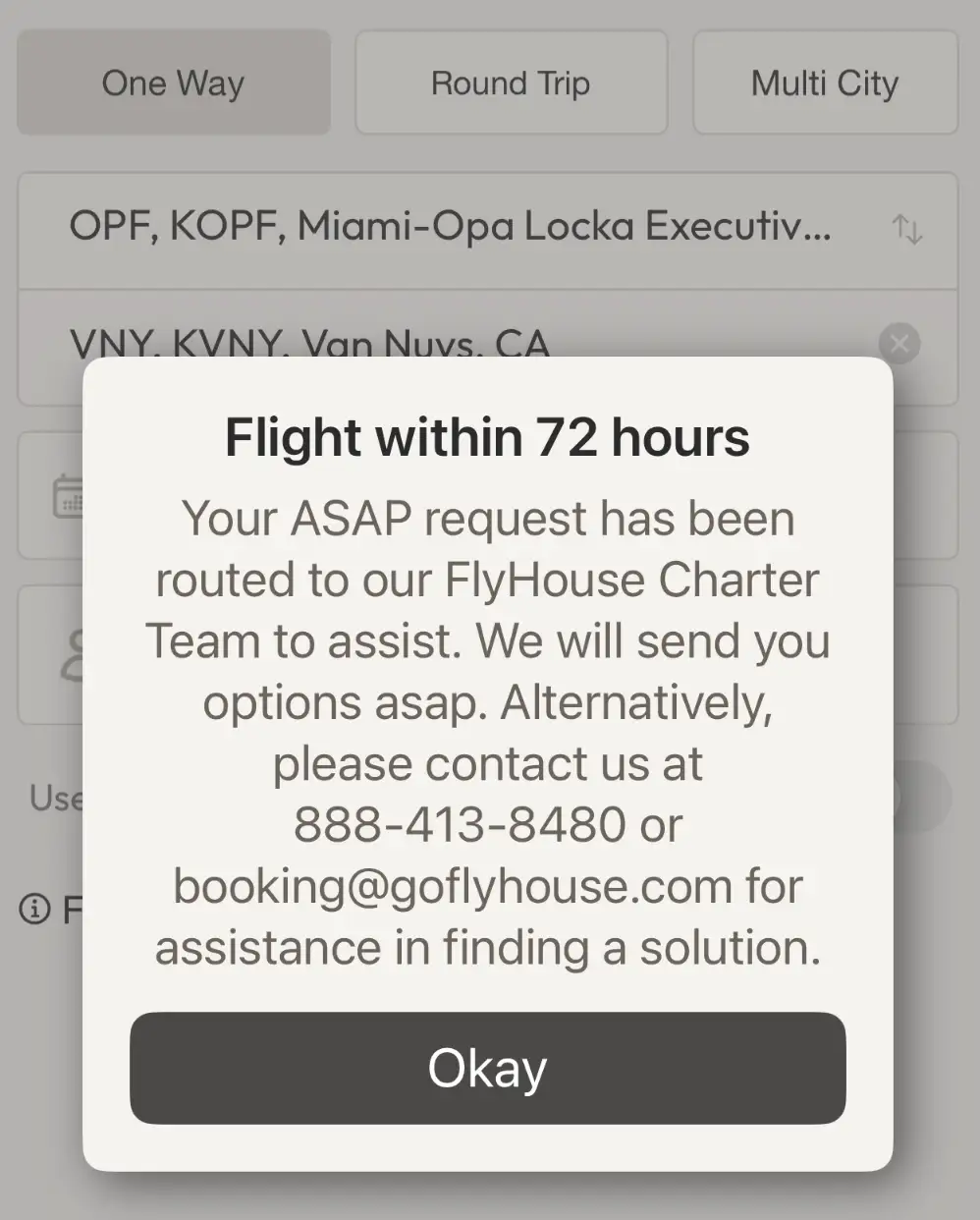
For example, with FlyHouse, the instant booking only works for flights at least 72 hours in advance.
Data from Avinode, a marketplace used by operators to source aircraft, shows that 10% of broker requests are for departures within 24 hours.
20% are charter flight requests for same-day, next-day, or day-after departures.
![FlyHouse ASAP booking]()
Also, the apps only have a subset of relevant available charter aircraft.
Therefore, for flyers, using a single digital booking platform may not offer the best options, either in price or in the desired aircraft.
One broker notes that there are over 100 aircraft types available for charter, with varying vintages and seating and luggage configurations.
Nonstop range varies based on weather, runway length, and load.
The broker said of the apps he has tried, “They offer no guidance on what aircraft will work best.”
Worst Of Class
Not all instant booking apps are equal in terms of capabilities.
Some apps only allow users to select a cabin category, not a specific aircraft type.
Other instant booking apps that guarantee prices charge significantly higher rates than market rates.
In some cases, they offer booking on turboprops and light jets for flights from California to Hawaii, aircraft that don’t have the capability for the mission.
Other instant booking platforms offer charter jet bookings that couldn’t land at Santa Monica Airport.
Limitations include where instant pricing applies, typically within the Continental U.S.
Shortfalls for international bookings include identifying customs stops.
Special event fees, which can exceed $20,000 for large cabin jets, are not necessarily identified in advance.
FlyHouse Valuation
In 2024, investor Benevolent Capital’s Grant Johnson told attendees at the Corporate Jet Investor conference, “My belief is if (FlyHouse does) what I think they can do in the years to come and they do it on a global scale, I will be disappointed if this isn’t worth two
to three billion on the low side in five years.”
Michelman says FlyHouse is continually enhancing its offerings, making significant investments.
He predicts the company will entice more HNW flyers to book their charter flights online.
Michelman believes that beyond the instant booking, FlyHouse offers physical, emotional, financial, and cyber safety and security for flyers.
Access to additional data required a non-disclosure agreement.