April 1, 2026
Wheels Up reported its first Adjusted EBITDA and EBITDAR profits in Q4 2025, as quarterly net loss dropped to $28.9 million.
Wheels Up this morning reported its fourth-quarter and full-year 2025 financial results.
It posted its first quarterly Adjusted EBITDA and Adjusted EBITDAR profits as a public company.
The company was founded in 2013 and went public via a July 2021 SPAC IPO.
Adjusted EBITDA was $32.9 million, a year-over-year improvement from an $11.3 million loss in Q4 2024.
Adjusted EBITDAR was a positive $36.9 million compared to a $3.2 million loss in 2024.
It was also a quarter-to-quarter improvement over the $23.2 million EBITDA loss in Q3 2025 and a negative $19.7 million EBITDAR.
The company said numbers were held back by “transitory inefficiencies associated with fleet modernization,” which brought down the adjusted contribution margin by 3.5 points in the most recent quarter.
| (in millions) | Q4 2024 | Q1 2025 | Q2 2025 | Q3 2025 | Q4 2025 |
| TTL Gross Bookings $ | 314.0 | 214.9 | 261.9 | 266.6 | 269.0 |
| Block Sales $ | 190.0 | 133.0 | 127.0 | 127.0 | 188.0 |
| Revenue $ | 204.8 | 177.5 | 189.6 | 185.4 | 183.8 |
| Gross profit (loss) $ | 15.5 | (1.1) | 2.2 | (1.3) | 12.8 |
| Adjusted Contribution $ | 39.6 | 22.4 | 23.7 | 23.5 | 35.0 |
| Adjusted Contribution Margin | 19.3% | 12.6% | 12.2% | 12.7% | 19.1% |
| Net loss $ | (87.5) | (99.3) | (82.3) | (83.7) | (28.9) |
| Adjusted EBITDA $ | (11.3) | (24.2) | (29.0) | (23.2) | 32.9 |
| Adjusted EBITDAR $ | NA | (18.8) | (25.1) | (19.7) | 36.9 |
Source: Wheels Up
Gross profit, $12.6 million for the year, compared to $2.5 million in 2024, was negatively impacted by about $9 million for the same reason, according to the press release.
Wheels Up posted a 67% reduction in net loss, from $87.5 million in Q4 2024 to $28.9 million in Q4 2025.
The Q3 2025 net loss was $83.7 million.
Wheels Up attributed the smaller net loss to a “stronger mix of profitable membership and charter flying, exit of unprofitable fleets, early progress toward its $70 million annual run-rate cost reduction target, and one-time gains from aircraft sale-leaseback transactions.”
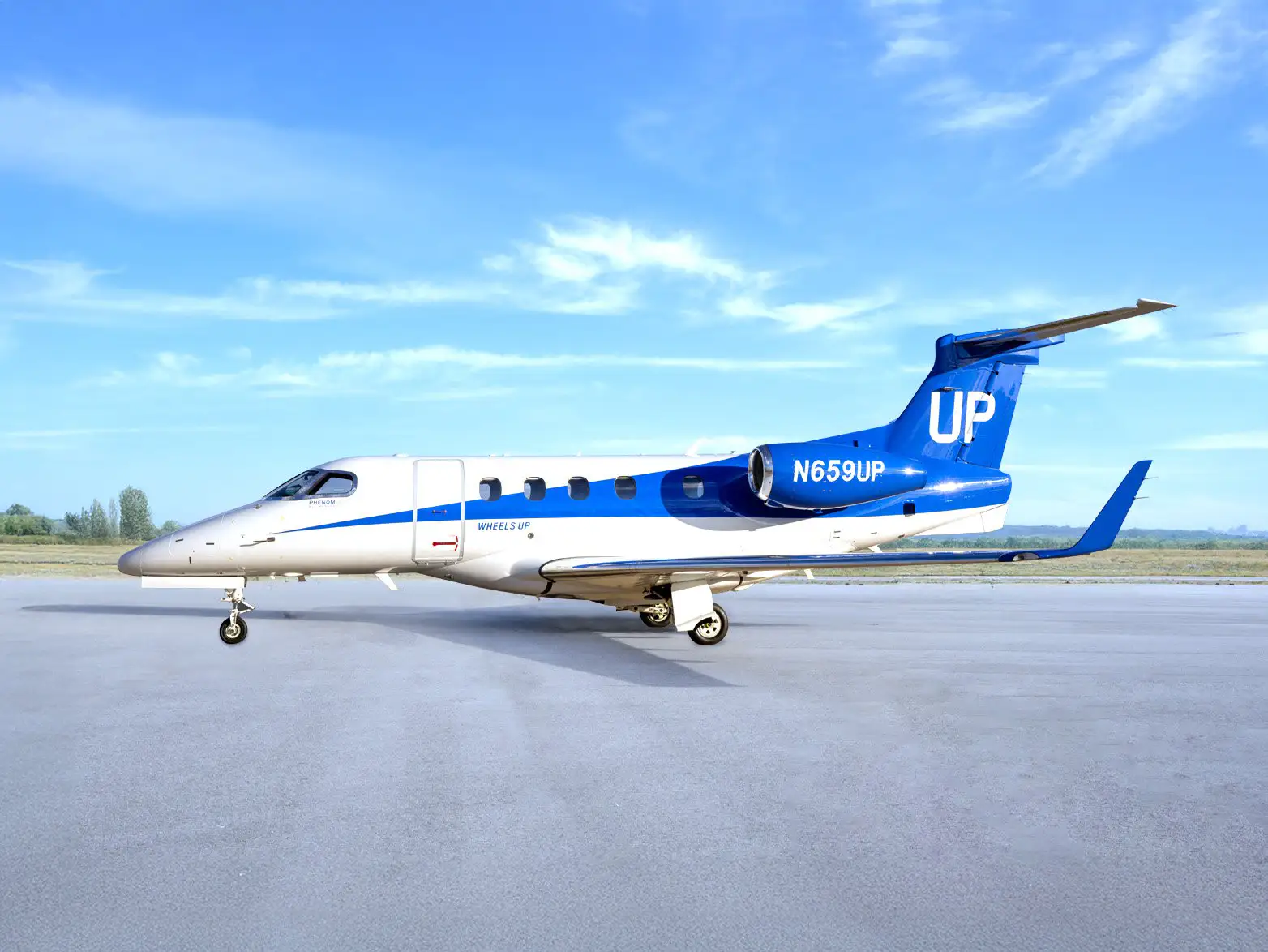
The December sale-leaseback agreement covered three Challenger 300s and seven Phenom 300s, raising $105 million.
At the time, the Delta Air Lines-backed private aviation company said it would use $65 million to pay debt from its revolving equipment notes facility.
The remainder, $40 million, would be added to the company’s balance sheet.
Full-year net loss dropped from $339.6 million in 2024 to $294.2 million last year.
Operating loss decreased by 21% to $203.4 million.
Adjusted EBITDA loss declined from $117.9 million in 2024 to $43.5 million in 2025.
Adjusted EBITDAR loss fell to $26.7 million from $84.6 million year-over-year.
| (in millions) | 2018 | 2019 | 2020 | 2021 | 2022 | 2023 | 2024 | 2025 |
| Total Gross Bookings $ | NA | NA | NA | NA | NA | NA | 1,043.8 | 1,039.5 |
| Block Sales $ | NA | NA | 530.0 | 897.0 | 1,005.0 | 482.0 | 595.0 | 576.0 |
| Total Revenue $ | 332.0 | 385.0 | 695.0 | 1,194.3 | 1,579.8 | 1,253.3 | 792.1 | 736.5 |
| Gross profit (loss) $ | 14.0 | 5.0 | 1.7 | 22.4 | (26.5) | (37.7) | 2.5 | 12.6 |
| Adjusted Contribution $ | 49.0 | 44.0 | 62.4 | 82.2 | 57.9 | 62.5 | 85.7 | 104.1 |
| Adjusted Contribution Margin | 14.7% | 11.5% | 9.0% | 6.9% | 3.7% | 5.0% | 10.8% | 14.1% |
| Net loss $ | (83.0) | (107.0) | (85.4) | (197.2) | (555.5) | (487.4) | (339.6) | (294.2) |
| Adjusted EBITDA $ | (14.0) | (21.0) | (52.4) | (87.4) | (185.3) | (145.9) | (117.9) | (43.5) |
| Adjusted EBITDAR $ | NA | NA | NA | NA | NA | NA | NA | (26.6) |
Source: Wheels Up
Wheels Up ended 2025 with $234 million in liquidity.
That includes $134 million of cash and cash equivalents and an undrawn $100 million Delta revolving credit facility.
There was $739.4 million in deferred revenue, down from $749.5 million the year before. Deferred revenue included prepaid funds for future flights.
Perhaps most importantly for customers, it completed 99% of flights in the quarter, with an on-time performance of 91%.
It also had 24 days without any cancellations in the quarter, the same as Q3, and started January with 14 more of what it calls Brand Days.
The improvements came despite a 7% decline in revenue from $792.1 million in 2024 to $736.5 million in 2025.
The revenue decline was partly due to Wheels Up’s continued sales of non-core businesses.
Total Gross Bookings, which accounts for the full retail value of charter bookings to third-party operators (rather than just the margin between retail price and wholesale cost), was essentially flat at just over $1.0 billion.
Private Jet Gross Bookings were up 3% to $833.9 million.
Cargo charters in 2024 related to storm relief missions and group charters as part of the POTUS election cycle offset the gains in private jet charter flights.
Live flight legs were down 11% year-over-year, while revenue per leg increased 15%, reflecting Wheels Up’s fleet transition to newer, more premium aircraft.
“(There are) a lot of green shoots and a lot of things we’re excited about heading into ’26, and a lot of work to do, but we have a plan that we really built back in late ’24 that we’re still executing against, and we know where we’re going,” CEO George Mattson told Private Jet Card Comparisons in an interview yesterday afternoon.
“We are advancing toward our long‑term objective of sustainable, profitable growth,” Mattson said in the release announcing the results.
From 2023 to 2025, Mattson says, Wheels Up increased its corporate block sales from $150 million to $250 million.
The increase in business travelers means more than just revenue.
It is a lynchpin of the turnaround plan Mattson has been spearheading since moving from the Delta Air Lines board to the private jet company in October 2023.
Mattson’s arrival coincided with $500 in funding from an investor group led by Delta after Wheels Up came inches from bankruptcy that summer.
The goal is to achieve a more balanced mix of leisure flyers who travel Thursday through Sunday and business travelers who fly Monday through Thursday.
Despite acquiring a half-dozen operators, including Delta Private Jets, a deal that closed in January 2020, Wheels Up’s nearly 90% leisure focus often left it with insufficient capacity on Thursdays, Fridays, and Sundays.
Instead, it had to spend hundreds of millions of dollars to fly members on other operators for their weekend trips.
The lack of business travelers also meant its jets and flight crews, which it was paying for regardless of whether they flew, were underutilized during the workweek.
Mattson says the shift means flying is now in a more balanced pattern.
Mattson says that since launching its new Signature jet card in September, it has signed up over 600 members, 75% of whom are legacy program members transitioning.
It is also seeing a high percentage of old faces, members who left during the turmoil and reductions in guaranteed rate PSA, coming back.
Signature offers guaranteed fixed rates nationwide, although Mattson says more joiners are choosing its dynamic pricing option.
Also, moving forward, is the fleet modernization plan.
Phenom 300s and Challenger super-midsize jets were about 40% of its fleet at the end of 2025.
Mattson says the renewal program should be completed by year’s end, six months ahead of schedule.
It has increased its Phenom fleet by more than 50% since acquiring GrandView Aviation in 2024.
It is expected that its 25 or so remaining King Air 350s will soon be leaving, although Mattson declined to comment on specific disposal plans.
Wheels Up ended sales of its guaranteed-rate turboprop program in December, although it is honoring existing rate guarantees.
The top-selling Embraer light jets and the stand-up-cabin Challengers, all of which are receiving new interiors and high-speed Gogo connectivity, support its pitch to Delta’s blue-chip corporate accounts.
Mattson says those companies are looking for quality, flexibility, and reliability, something he says Wheels Up now delivers.
Mattson says there is a significant opportunity to leverage Delta’s expertise in business travel management for corporate flight departments serving multiple users in diverse locations across their companies.
Offering on-fleet programmatic and ad hoc custom charters through a single point of contact improves efficiency and oversight for companies.
Corporate travel managers have voted Delta the top airline for business travel in the Business Travel News Airline Survey for 15 consecutive years.
Companies with their own corporate aircraft are heavy users of fractional ownership, jet cards, and ad hoc charter for supplemental lift.
Mattson says the recent restructuring of sales and service groups into teams dedicated to client groups is already showing results.
The changes were announced in January.
“We took our separate Wheels Up and Air Partner sales teams and service teams and reorganized them together as one, unified the brand, and then organized it consistent with the organizational structure of the Delta Air Lines sales team,” Mattson says.
Mattson adds, “We think that’s going to drive growth.”
The change ended a series of internal handoffs and now provides the customer with a more integrated service experience, he says.
“Very importantly, it took out all the handoffs and touch points in our previous system and created vertically integrated teams that service everything about a customer, whether it’s sales, renewals, managing the account, day of flight, servicing the flight, catering, or ground transportation,” he says.
“We’re already hearing feedback from customers in the first few weeks that they noticed a difference in their last flight,” Mattson adds, citing accuracy of communication ahead of the flight, “the whole experience.”
They noticed differences in accuracy across communication, changes, catering, ground transportation, and the overall experience.
Mattson says, “A lot of the work we’ve done to this point was to get to this point.”
In 2022 and 2023, Wheels Up posted net losses of over $1 billion.
Mattson said, “It has been transformational work, restructuring work, building the house, building the foundation of the housework around the operation, the go-to-market strategy, the fleet, and those pieces are now in place.”
During a 2024 interview with Delta CEO Ed Bastian, when asked about the integration of Wheels Up to the airline’s customers, he said, “We’re not going to put the Wheels Up brand on the Delta app until we’re confident in the delivery of the same level of expertise and excellence of service.”
Bastian said of Wheels Up at the time, “It needs to clearly be a premium experience above Delta’s most premium commercial experience.”
Asked whether Wheels Up was there yet, Mattson pointed to Delta’s latest earnings report yesterday.
Delta had operating revenue of $63.4 billion in 2025, with operating income of $5.8 billion, and pre-tax income of $6.2 billion.
Mattson says, “If you looked at their last earnings report, the premium travel segment outperformed everything else.”
He continued, “We’re ready to really drive that value…to broaden and deepen our partnership with Delta…They feel the same way, and so that’s where we’re going to be spending a lot of time going forward.”
In December, Wheels Up enabled members to book Delta flights online using their private jet block funds.
While critics have been skeptical of Delta’s continued backing of the private jet service, Mattson says it’s no longer a one-way street.
“We get a lot of value, a tremendous amount of value from the partnership. But they also view this as a very important part of their premium strategy,” Mattson says.
UP closed yesterday at 70 cents, closer to its 52-week low of 56 cents than its high point of $3.50.
It is currently facing another NYSE notice indicating a possible delisting.
Delta, trading at just over $71, was off its full-year high of $76 and more than double its low of $34 per share.
UP starts today with a market cap of $508.7 million.
DAL is valued at $46.4 billion.
Last November, during a Corporate Jet Investor event in Miami, Mattson told naysayers in the audience, “Things can flip quicker than you think.”
Five years ago this month, as Wheels Up was pitching its business to analysts and the media during a pre-IPO Investors Day, Mattson was busy with Bastian drumming up financing after Delta’s record $12 billion loss in 2020 when COVID grounded most of the travel industry.
Yesterday, speaking about his current challenge, Mattson said, “We’re at an inflection point, a pivot point….2026 is a pivot year where we get to the other side of a lot of the work that we’ve been doing,” before adding, “Nothing is easy about any of this, but we’re going to continue to see improvement.”
DOWNLOAD: WHEELS_UP_FY_2025

Find the perfect solution for your private aviation needs
Save Time. Buy Confidently.
Receive an apples-to-apples comparison of programs that meet your needs from more than 500 jet card and fractional options covering 65 points of differentiation and over 40,000 data points.